From Piggy Bank to Purpose. Helping Kids Choose Their First Savings Goal
- Feb 9
- 5 min read

Most little kids feel the same way about money.
“I want that.”
“And that.”
“And that too.”
Everything looks good.Everything feels urgent.
So when we say, “You should save your money,” it can sound to them like,
“Put your fun away.”
Saving feels like losing if there is no picture attached to it.
Your job is not just to tell them to save.It is to help them move from:
“I want everything.”
to
“I am saving for this one thing.”
That is where the piggy bank and the Choice Jar work together.
The piggy bank catches the money.
The Choice Jar gives it a job.
In this post, we will walk through how to:
Brainstorm possible goals.
Pick one that fits their age.
Track progress in a visual, fun way.
So saving feels exciting, not restrictive.
And your child gets that first real “I did it” moment with money.
Stage One. Let the Piggy Bank Catch the Crumbs

In Colby Jack’s world, his piggy bank Porkster Banks is the first stop.
It is where every crumb goes when it is new.
The same is true in real life.
Before kids can choose a goal, they need a place to catch their money.
That can be:
A piggy bank.
A jar.
A small box they decorate.
The point is not perfection.
The point is
“This is where my crumbs go when I get them.”
At this stage, your main messages are:
“Money goes in the bank first, not out of your hand right away.”
“We put it somewhere safe so we can decide what to do with it.”
You are teaching them that saving is the starting point.
Not the leftover.
Why “Save Your Money” Feels Vague
For a young child, “save your money” is huge and fuzzy.
Save for what?
Save for how long?
Save how much?"
If there is no picture attached, their brain fills it with “forever.”
And forever feels too big.
That is why a single, clear goal matters.
When a child goes from:
“I am saving because Mom said so.”
to
“I am saving for that blue truck with the ladder.”
something shifts.
Saving has a purpose.
And purpose is what keeps them going.
Step 1. Brainstorm Possible Goals Together

Sit with your child and talk about things they like.
You can make this light and playful.
Ask:
“What are some things you really love right now?”
“If you could pick one special thing to save for, what might it be?”
“What sounds fun to you? A toy, a game, an experience, a trip to somewhere small?”
You can help by offering a few examples:
“A new book about space.”
“A small Lego set.”
“A trip to the trampoline park with Dad.”
Write down their ideas or draw little pictures.
This part is about dreaming, not editing.
Let them feel big for a minute.
Step 2. Pick a Goal That Fits Their Age

Once you have a list, you gently bring it closer to their world.
For younger kids (around 3 to 6):
The goal should be reachable in weeks, not a year.
The cost should match what they could reasonably save from allowance, small jobs, or gifts.
You can help by saying:
“This game might take a long time to save for. Maybe we save for something a little smaller first so you can feel what it is like to reach your goal.”
“Which of these could you see yourself getting in the next month or two”
You are not shutting them down.
You are helping them choose something that lets them win early.
Their first savings goal is not about the size of the item.
It is about the feeling of “I did it.”
Step 3. Move From Piggy Bank to Choice Jar
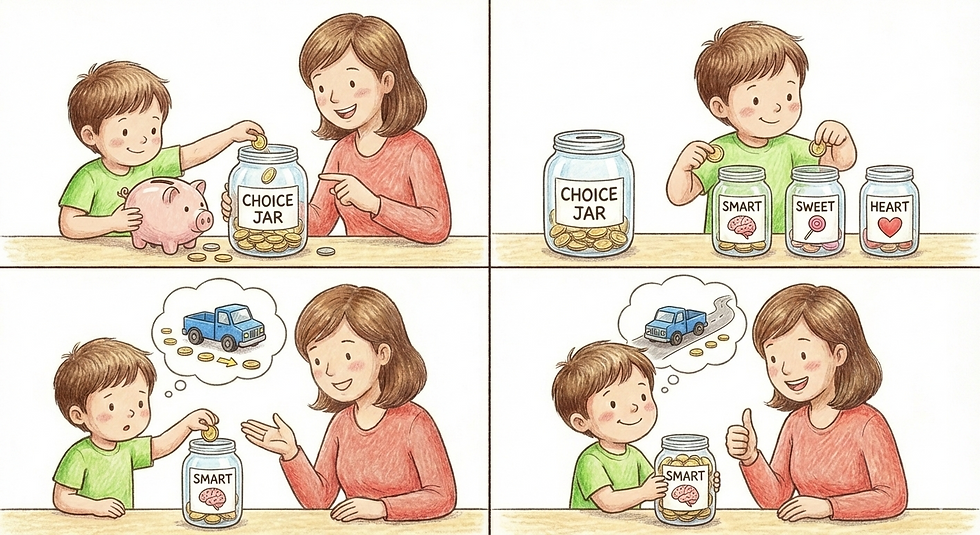
Once they pick their goal, it is time for the next stage.
The piggy bank is where the money lands.
The Choice Jar is where the decision happens.
You can say:
“Your crumbs will still go into your piggy bank first.Then, when we are ready, we will open it together and move some into your Choice Jar.”
In the Choice Jar system:
Smart is for saving.
Sweet is for spending now.
Heart is for giving.
For their first real goal, you might say:
“This time, we are going to focus on a Smart goal.That means when you put crumbs into the Smart jar, they are marching toward your blue truck.”
Now “Smart” is not just a word.
It is connected to something they can see in their mind.
Step 4. Make Progress Visual

Kids live in the now.
They need to see progress, not just hear about it.
You can use a simple visual tracker:
Draw a picture of the item they are saving for and put small boxes around it.
Create a thermometer or path with 10 sections.
Use a sticker chart where each sticker is worth a certain number of crumbs.
Every time they add money to their Smart jar, they get to:
Color in one box.
Put on one sticker.
Move a marker up the “savings thermometer.”
You might say:
“Look at that. You are halfway to your goal.”“Each time you add a crumb, your picture gets a little more complete.”
Now saving becomes a game they can see, not just a rule they have to follow.
Step 5. Handle the “I Want It Now” Moments

Even with a goal, your child will have moments of wanting to spend early.
At the store.
When a new toy catches their eye.
When a friend shows them something different.
Instead of getting frustrated, you can treat those moments as training.
You might say:
“I know it is hard. You saw something you want right now.”
“You also chose a Smart goal for your blue truck. Which matters more to you today”
“If you change your mind, we can talk about it. But remember, your crumbs can only do one job at a time.”
You are not forcing them.
You are reminding them they have power.
If they choose to stick with the goal, celebrate that.
If they decide to spend some and adjust the goal, walk through the impact:
“If we spend this today, it might take longer to reach your blue truck. Are you okay with that?”
This teaches them that choices have trade offs.
And that they are capable of thinking through them.
Step 6. Celebrate the “I Did It” Moment

When they finally reach their goal, make it a big deal.
Let them:
Help count the money.
Bring it with them to the store.
Hand it to the cashier or be part of the online checkout.
Then say what you see:
“You did this. You waited. You saved. You reached your goal.”
“How does it feel to know you paid for this with your own crumbs”
Pause and really let that pride land.
That feeling is the real win.
The toy or experience will fade.The memory of “I can save and get there” will not.
Step 7. Choose the Next Purpose Together

After they reach their first goal, you can say:
“Now that you have done this once, what do you want your next Smart goal to be”
You might suggest something slightly bigger this time.
They already have proof that they can wait and succeed.
Over time, you can introduce:
Saving for experiences, not just things.
Splitting between Smart and Heart goals.
Longer time frames with check in points.
But all of that starts with one small, age appropriate win.
From “Put It Away” To “I Have a Plan”
Saving does not have to feel like losing.
With a piggy bank to catch the crumbs, a Choice Jar to give them a job, and one clear picture in your child’s mind, you can turn “save your money” into something different.
“I know what I am working toward.”
“I can see myself getting closer.”
“I did it.”
That first savings goal is not just about the toy or trip.
It is about shifting your child’s story from
“I just want everything”
to
“I know how to choose.”
One piggy bank.
One goal.
One proud little “I did it” at a time.
And remember,


